Why Discord Communities Fail in Their First 30 Days
Most Discord servers don't fail because of bad ideas — they fail because they struggle to turn new members into an active community. Here are the most common mistakes communities make during their first 30 days and how to avoid them.
Why Discord Communities Fail in Their First 30 Days
Starting a Discord server is easy.
Building a community isn't.
Every day, new Discord servers are created around gaming, creators, projects, friendships, development, roleplay, and thousands of other interests. Many launch with ambitious plans: hundreds of members, active conversations, events, partnerships, and a recognizable community.
But then something happens.
A few people join. Someone says hello. The owner posts a few announcements.
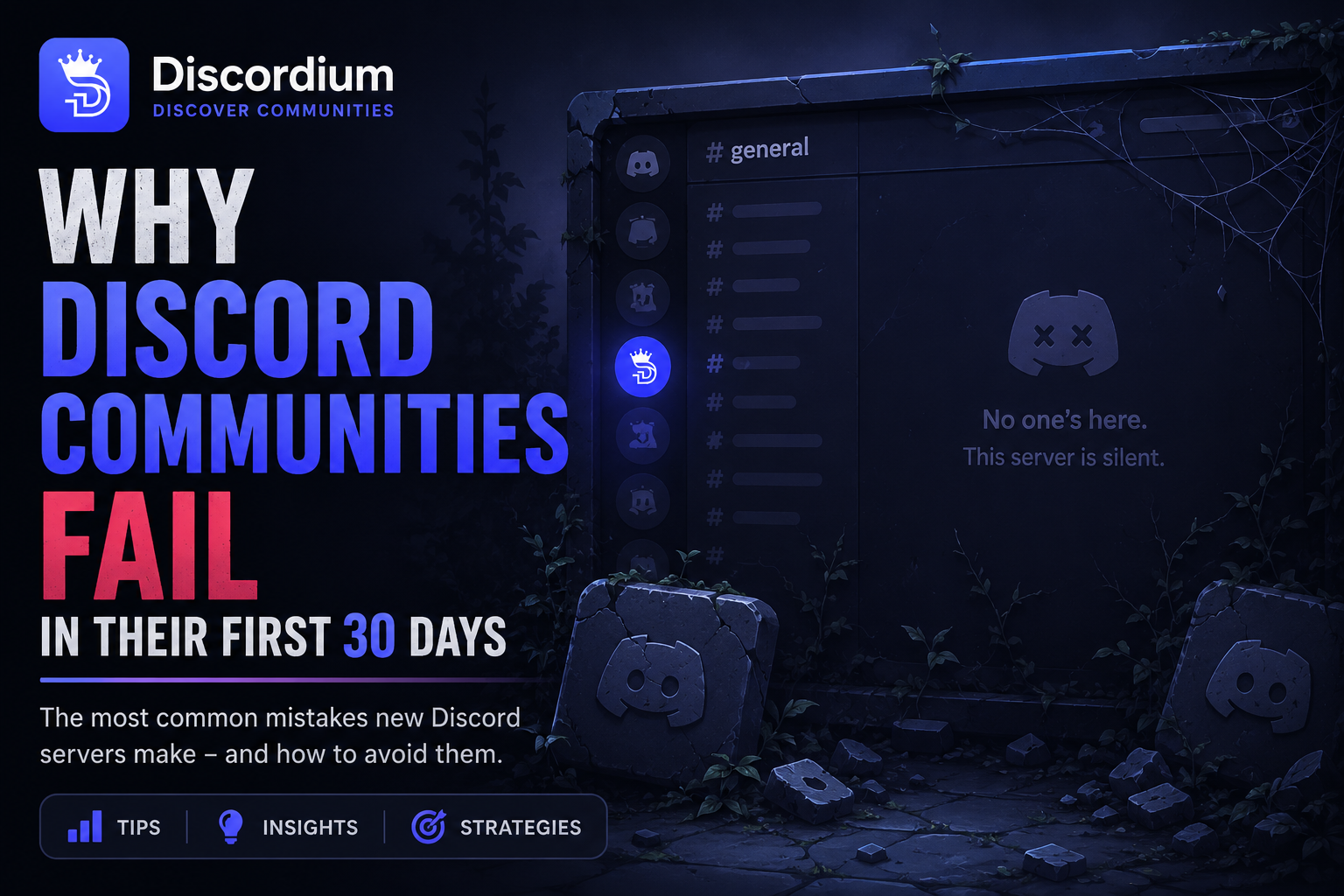
And two weeks later, the server is silent.
The first 30 days can determine whether a Discord community develops momentum or becomes another abandoned server.
So why do so many communities fail so quickly?
1. They launch before there's actually a community
One of the most common mistakes is focusing entirely on building the server instead of building the community.
The owner spends days creating:
dozens of channels
complicated role systems
custom emojis
bots
level systems
reaction roles
elaborate category structures
Then the server launches.
And nobody talks.
A technically impressive Discord server isn't automatically an interesting community.
Before worrying about having the perfect setup, ask a more important question:
Why should someone come back tomorrow?
People don't return because your server has 40 channels.
They return because something — or someone — gives them a reason to.
2. There are too many empty channels
Opening a new server with dozens of channels can actually make it feel less active.
Imagine joining and seeing:
#general#gaming#memes#media#music#off-topic#clips#pets#technology#movies
Almost all of them are empty.
Instead of making the community look large, this highlights how little activity exists.
For new communities, fewer active channels are usually better than dozens of inactive ones.
Start small.
You can always add new channels when conversations naturally require them.
3. The owner waits for members to create activity
This is one of the biggest early mistakes.
A server owner creates the community, invites people and then waits.
But during the first few weeks, the owner and staff often need to create the initial momentum themselves.
Start conversations.
Welcome people.
Ask questions.
Share interesting content.
Create small events.
Respond when someone posts something.
If a new member sends a message and receives no response for six hours, they may never send another one.
Early communities require active leadership.
Eventually, members can become the people creating conversations themselves.
But you usually have to get that cycle started first.
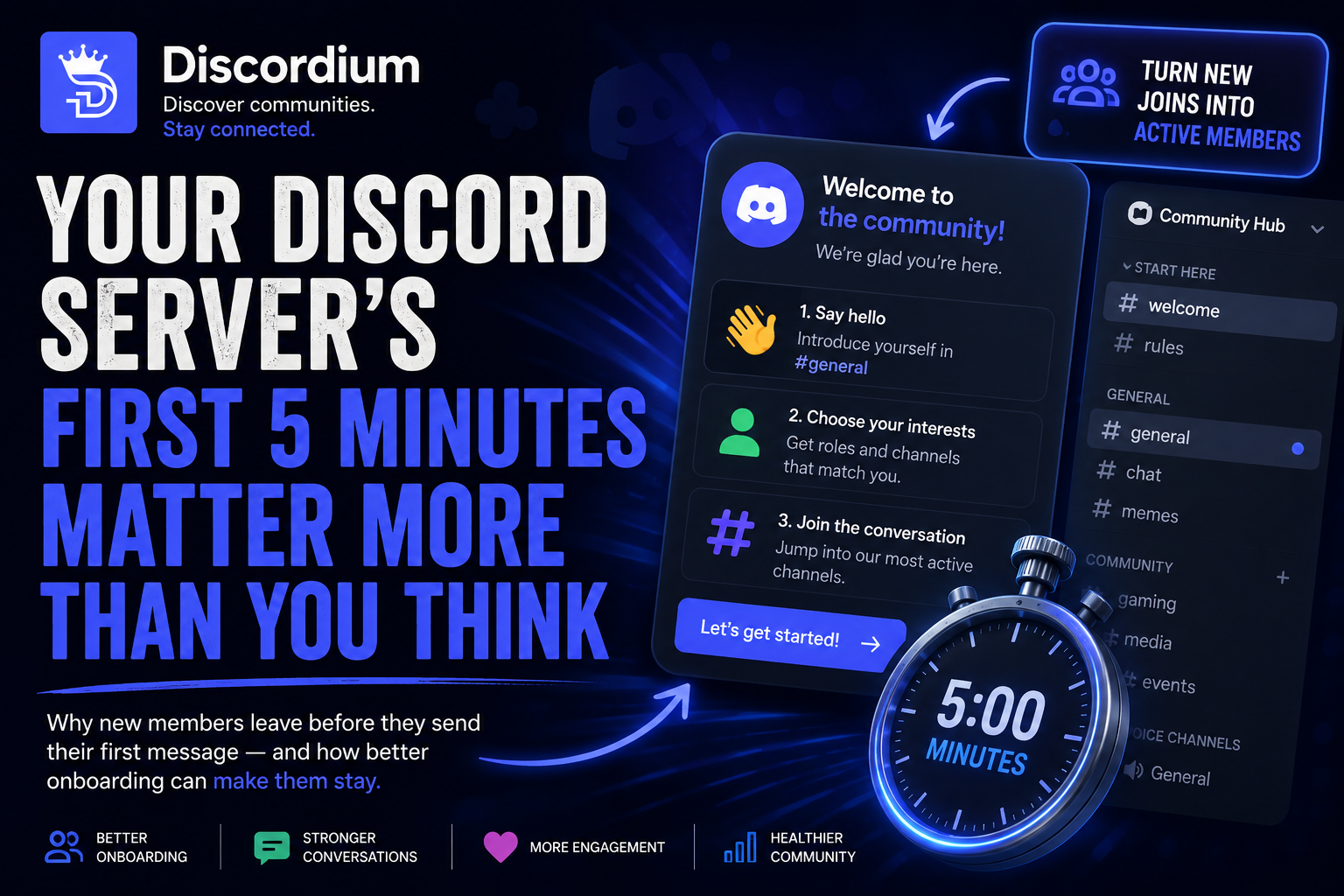
4. New members don't know what to do
A new member joins.
They're immediately presented with rules, verification, roles, announcements, information channels, introductions and perhaps several bot messages.
Then they reach the server.
Now what?
Good onboarding should answer three questions quickly:
What is this community about?
Where should I start?
What can I do here?
If joining feels like completing paperwork, people will leave.
Keep onboarding simple.
Show members the important information and get them into the actual community as quickly as possible.
5. They're obsessed with member count
1,000 members doesn't necessarily mean you have a community.
A server with 80 members and 15 people regularly talking can be healthier than a server with 5,000 members where nobody speaks.
This is especially important during the first month.
Owners sometimes become so focused on reaching 100, 500 or 1,000 members that they forget about the people who already joined.
Instead of constantly asking:
How do we get more members?
Ask:
How do we make our existing members want to stay?
Retention matters.
A server that attracts 100 people but loses 90 of them has a bigger problem than a server growing slowly with members who actually stay.
6. They promote too aggressively
Promotion matters.
Spam doesn't.
Posting your invite everywhere, sending unsolicited DMs, constantly asking for partnerships or using questionable growth methods might generate joins.
But joins alone don't build communities.
The goal shouldn't be getting the largest possible number of people through the door.
It should be attracting people who are actually interested in what happens inside.
Describe your community accurately.
Promote it where relevant.
Give people a genuine reason to join.
Good discovery connects the right community with the right person.
7. There's nothing unique about the server
Consider this description:
Friendly community where everyone is welcome. We have giveaways, bots, gaming, memes and active staff!
There are thousands of Discord servers that could use exactly the same description.
Why should someone choose yours?
Successful communities usually develop an identity.
That might come from:
a specific game
a creator
a niche interest
a project
a unique culture
regular events
specialized knowledge
an existing friend group
something members create together
You don't need to reinvent Discord.
But people should understand what makes your community different.
8. Staff teams become too complicated too early
A server has 25 members.
But somehow it already has:
Owner → Co-Owner → Head Admin → Senior Admin → Admin → Junior Admin → Head Moderator → Moderator → Trial Moderator
You probably don't need that.
Large staff structures can make a small community feel unnecessarily corporate and create internal drama before the server even has something to moderate.
During the early stages, keep responsibilities simple.
Add staff because there's actual work that needs to be done — not because you want a large staff list.
9. Everything is automated
Bots are incredibly useful.
They can handle moderation, roles, verification, logging, tickets, statistics and many repetitive tasks.
But bots can't replace community interaction.
If every interaction with your server is automated, the community can start feeling like a dashboard rather than a place full of people.
Automation should support your community.
It shouldn't become your community.
10. They expect growth to happen immediately
This may be the most important point.
Communities take time.
Your first week might have five members.
Your first announcement might receive two reactions.
Your first event might have three participants.
That's okay.
Those three people could eventually become some of your most active members.
Instead of trying to manufacture the appearance of a huge community, focus on creating a good small one.
Then build from there.
What should you focus on during the first 30 days?
Forget about becoming the next massive Discord server for a moment.
Your first month should be about building a foundation.
Focus on:
Week 1 — Foundation
Define what your community is about, keep your server structure simple and make joining easy.
Week 2 — Interaction
Talk to members. Learn why they joined. Start conversations and experiment with activities.
Week 3 — Retention
Look at what's working. Which channels are actually being used? Where do conversations happen? What makes people return?
Week 4 — Growth
Once the community has some activity and identity, start expanding your discovery and promotion efforts.
Growth works much better when new members arrive somewhere that already feels alive.
Your first members matter more than you think
The first 10, 20 or 50 people in your Discord server can influence what the community eventually becomes.
They establish inside jokes.
They start conversations.
They suggest improvements.
They welcome future members.
They shape the culture.
Treat those people as community members rather than statistics.
Because ultimately, that's the difference between a Discord server and a Discord community.
A server can be created in minutes.
A community has to be built.
Build something people want to return to
The first 30 days aren't about having the biggest server.
They're about proving that your community has a reason to exist.
Keep things simple.
Talk to your members.
Create an identity.
Listen to feedback.
Promote responsibly.
And give people a reason to open Discord tomorrow and come back.
Because sustainable growth doesn't start with more members.
It starts with the members you already have.
Discordium.org — Discover communities worth joining.