How to Build a Discord Community People Actually Want to Stay In
Build a Discord community people actually want to stay in. Learn how better onboarding, engagement, moderation, events, and community culture can turn new members into active, long-term participants.
Getting people to join your Discord server is easy compared to getting them to stay.
You can advertise your server, appear on discovery platforms, run giveaways, build partnerships, and share invite links everywhere. But none of that guarantees you are building a real community.
A server with 10,000 members can feel completely dead.
A server with 300 members can feel alive every single day.
The difference is not simply size.
It's community.
In this guide, we'll look at what makes Discord communities successful, why members leave, and what you can do to turn new joins into active, long-term members.
1. Give People a Reason to Join — and Stay
Before thinking about bots, roles, advertisements, or partnerships, answer one question:
Why should someone join your server instead of another one?
"Gaming community" isn't enough.
"Friendly community" isn't enough either.
Thousands of Discord servers describe themselves exactly like that.
Successful communities usually have a clear identity.
That identity might come from:
A specific game or interest
A creator or brand
A unique community culture
Events and competitions
Educational resources
Exclusive content
Networking opportunities
A strong social environment
Your server should have something members can associate with.
When someone asks:
"What's this server about?"
The answer should be obvious.
2. Your First Five Minutes Matter
Imagine joining a Discord server for the first time.
You see:
47 channels.
23 roles.
Three verification bots.
A huge wall of rules.
And absolutely no idea where you're supposed to talk.
You probably won't stay very long.
New members should immediately understand three things:
Where am I?
What can I do here?
Where should I start?
Keep your entry experience simple.
A new member should ideally see only the channels that actually matter at first.
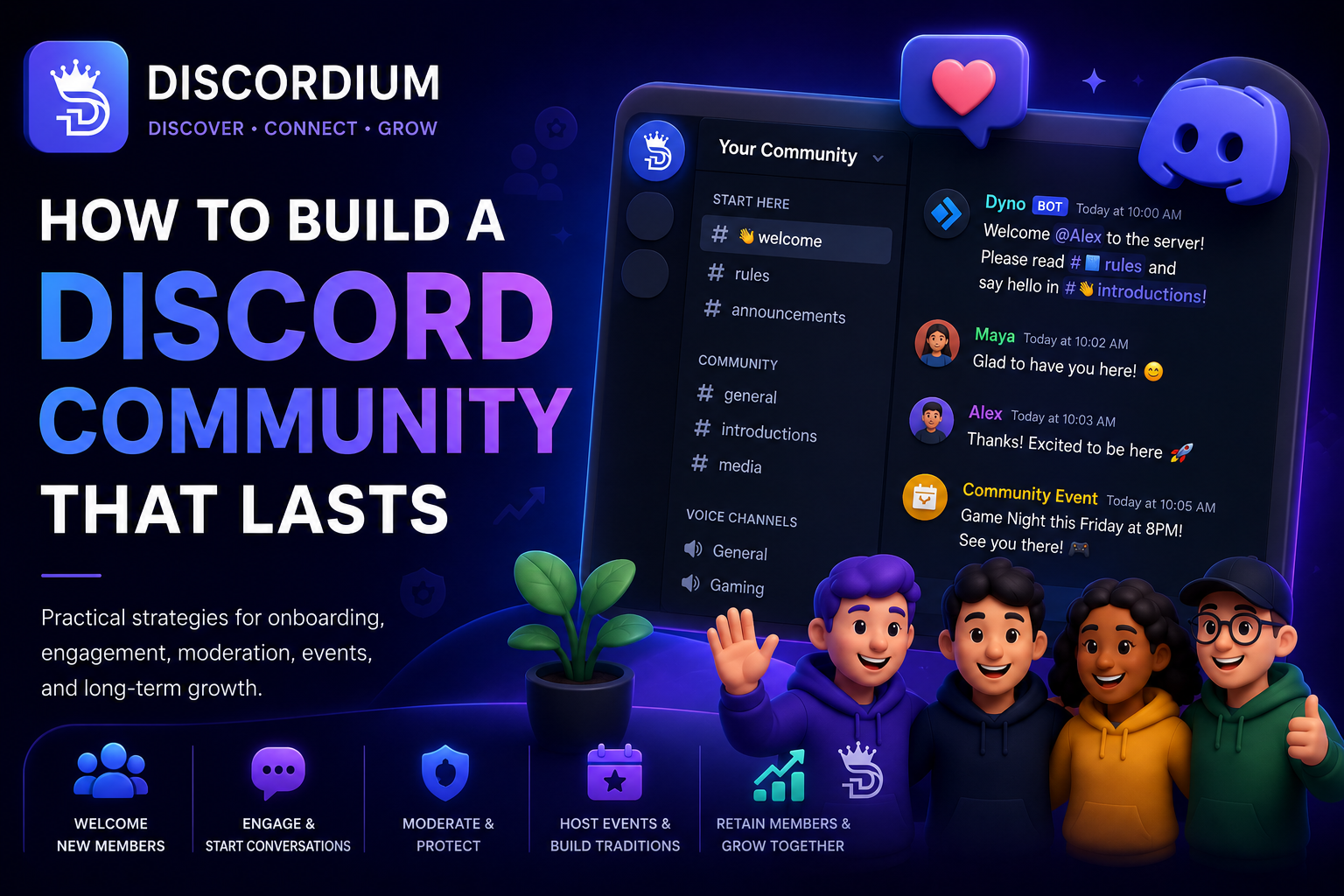
For example:
START HERE
#welcome
#rules
#announcements
COMMUNITY
#general
#introductions
#media
SUPPORT
#help
Additional channels can become available through roles or Discord's onboarding system.
The goal isn't to show members everything.
The goal is to help them find something worth doing.
3. Don't Build 50 Empty Channels
One of the most common mistakes when creating a Discord server is building too much too early.
You don't need:
#general-1
#general-2
#gaming-chat
#gaming-chat-2
#memes
#memes-2
#random
#random-2
when your server has 30 active members.
Empty channels make a community look inactive.
Instead of spreading 50 conversations across 50 channels, concentrate activity into a smaller number of useful spaces.
Add new channels when your community actually needs them.
A busy server with 10 channels feels much more alive than an empty server with 100.
4. Turn New Members Into Participants
A member joining your server isn't the end of your growth funnel.
It's the beginning.
Your next goal should be getting them to perform their first meaningful action.
That could be:
Sending their first message
Introducing themselves
Choosing an interest role
Joining a voice channel
Voting in a poll
Participating in an event
Reacting to a discussion
Asking a question
That first interaction matters.
Someone who has already talked with other members has a reason to return.
Someone who joined, looked around for 30 seconds, and closed Discord probably doesn't.
Create opportunities for interaction immediately.
Instead of:
"Welcome @User!"
Try:
"Welcome @User! 👋 What game are you playing the most right now?"
Now you've created a conversation.
5. Stop Treating Member Count as Your Main Metric
Imagine two servers.
Server A
12,500 members
20 messages per day.
Almost nobody joins voice channels.
Events receive five participants.
Server B
850 members
Hundreds of messages every day.
Active voice channels.
Regular events.
Members recognize each other.
Which server has the stronger community?
Probably Server B.
Member count can look impressive, but activity tells you much more.
Pay attention to metrics such as:
Active members
Returning members
Messages and conversations
Event participation
Voice activity
New-member engagement
Member retention
Votes and interactions
Growth without retention is just a revolving door.
6. Give Your Community Something to Do
People need reasons to return.
A server consisting only of a #general channel eventually becomes repetitive.
Create recurring activities.
For example:
🎮 Gaming Communities
Weekly game nights, tournaments, LFG sessions or community challenges.
🎨 Creative Communities
Art competitions, showcases, feedback sessions or collaborative projects.
💬 Social Communities
Question of the Day, debates, polls, movie nights or community games.
💻 Developer Communities
Coding challenges, project showcases, help sessions or hackathons.
Consistency is more important than constantly inventing something massive.
A simple weekly event can become part of your community's identity.
7. Build Traditions
The strongest communities develop their own culture.
Inside jokes.
Recurring events.
Memes.
Nicknames.
Annual celebrations.
Community awards.
These things might seem insignificant, but they create something extremely valuable:
belonging.
Members stop thinking:
"I'm in this Discord server."
They start thinking:
"I'm part of this community."
That's a huge difference.
Community culture cannot be completely manufactured by administrators.
Give members room to create it themselves.
8. Your Staff Should Be Part of the Community
Moderators shouldn't only appear when someone breaks a rule.
If every interaction with staff is:
"Warning."
"Deleted."
"Muted."
"Read the rules."
then moderators start feeling like security guards instead of community members.
Good moderators participate.
They talk.
They help.
They welcome newcomers.
They join events.
They understand the community culture.
Moderation still needs to be consistent and professional, but community management is about more than enforcing rules.
9. Rules Should Protect the Community — Not Control It
Rules are necessary.
But a rulebook shouldn't feel like legal documentation.
Members should quickly understand what is expected of them.
Focus on rules covering things that actually matter:
Respect other members
No harassment
No scams or phishing
No spam
No illegal content
No NSFW content where prohibited
Follow Discord's Terms and Community Guidelines
Respect moderator decisions and appeal through the proper channels
Explain important rules clearly and enforce them consistently.
Ten understandable rules are usually more useful than fifty rules nobody reads.
10. Listen to Your Members
Your community will eventually tell you what it needs.
Sometimes directly.
Sometimes indirectly.
If an event consistently gets no participants, reconsider it.
If nobody uses a channel, maybe you don't need it.
If members repeatedly ask for the same feature, investigate it.
Create simple feedback opportunities:
What should we improve?
Which event should we host next?
Which channels do you actually use?
What would make you visit more often?
Your members experience your server differently than you do as an administrator.
That perspective is valuable.
11. Don't Ping Everyone for Everything
@everyone can generate activity.
Once.
Then people mute your server.
Notifications should feel valuable.
Consider opt-in roles such as:
🔔 Updates
🎉 Events
🎁 Giveaways
🎮 Gaming
📰 News
Members can choose what they actually want to receive.
When notifications are relevant, people are more likely to pay attention to them.
12. Growth Should Come After the Foundation
Advertising a bad server doesn't fix it.
It just sends more people into a bad experience.
Before heavily promoting your community, make sure you have:
A clear identity
Good onboarding
Active conversations
Clear rules
Reliable moderation
Activities for members
A reason to return
Then start scaling your discovery.
Promote your community through social media, partnerships, content, community directories and server discovery platforms.
The objective isn't simply:
Get more joins.
It should be:
Find people who actually belong in your community.
13. Study Why Members Leave
People leaving your Discord server isn't automatically a failure.
Interests change.
People become inactive.
Some users clean their server list.
That's normal.
But patterns matter.
If hundreds of people join and almost nobody stays, something is wrong.
Look at the journey:
Discovery → Join → Onboarding → First Interaction → Return → Regular Member
Where are people disappearing?
If many join but never interact, investigate onboarding.
If they interact once but never return, investigate your content and activities.
If active members suddenly leave, investigate moderation, culture, leadership, or major server changes.
Retention problems often reveal community problems before administrators notice them.
14. Let Members Shape the Community
Eventually, your community shouldn't depend entirely on you.
Members should start creating conversations themselves.
They should welcome newcomers.
They should organize gaming sessions.
They should suggest events.
They should create memes.
They should help other members.
That's when you've moved beyond simply operating a Discord server.
You've created a community.
Your role changes from constantly generating activity to creating an environment where activity can happen naturally.
Community > Member Count
There is no magic bot, advertisement, partnership, or growth strategy that can replace a good community.
Bots can automate tasks.
Discovery platforms can bring visitors.
Advertisements can generate joins.
But your community determines whether those people stay.
Focus on creating a place where members feel welcomed, have something to do, meet people they enjoy talking to, and have a reason to return tomorrow.
Because the most successful Discord server isn't necessarily the one with the most members.
It's the one people would actually miss if it disappeared.
Ready to grow your Discord community?
Discover new Discord communities or list your own server on Discordium.org and help more people find the community you've built.